


- AI, NetSuite ERP, NetSuite Financial Management
Artificial intelligence is now widely used across finance, with software providers promoting faster reporting, improved forecasting, and reduced manual processes. However, when you look beyond the marketing, the real question is simple: will the system make everyday work easier for your team?
The best AI accounting software is not about adding unnecessary features. It’s about helping organisations reduce repetitive administration, improve visibility, and make more informed decisions using accurate financial data.
For growing businesses, selecting new finance software is often less about AI itself and more about establishing stronger processes that can support long-term expansion.
AI accounting software in Ireland: Start with your business needs
When reviewing AI accounting software in Ireland, it’s best to begin with your operational needs rather than focusing purely on technology.
Many finance teams are still working with disconnected systems, spreadsheet-heavy reporting, delayed approvals, and manual data entry. AI and automation in finance can help improve these challenges, but only if the core system already aligns with how the business operates.
As organisations scale, finance becomes more closely linked with inventory, purchasing, projects, customer management, and reporting across multiple entities or locations. This means your solution must go beyond basic bookkeeping.
Before evaluating platforms, consider the following:
- • Does the system support your existing processes and controls?
- • Can it scale as your organisation grows?
- • Does it deliver reliable reporting and visibility?
- • Will AI driven accounting software integrate properly into approval workflows and permissions?
- • Can finance connect effectively with wider business operations?
The right solution should meet current needs while allowing room for future growth.
Accounting AI software should support real work
When assessing accounting AI software, it’s important to move past marketing claims and focus on real operational value.
Some platforms use AI to capture invoice data, automate transaction matching, or reduce manual processing. Others provide anomaly detection, trend analysis, or quick financial summaries.
These capabilities can make a meaningful difference, particularly for finance teams overwhelmed with repetitive tasks. However, accounting software with AI still requires human oversight. Finance professionals remain responsible for reviewing, validating, and interpreting results, especially in relation to compliance, forecasting, and decision-making.
The real benefit of AI powered accounting software is that it allows teams to spend less time on data collection and more time on analysis and insight.
For this reason, businesses should carefully evaluate how AI accounting software functions within daily workflows. Is it intuitive? Does it integrate naturally into existing processes? Can teams rely on the outputs? These considerations are often more important than headline features.
Why embedded AI matters
A key distinction between finance systems is whether AI is fully embedded or delivered through separate add-on tools.
Embedded AI works directly within your data, workflows, permissions, and reporting structures. This makes it significantly more effective for day-to-day operations because it aligns with how the business already functions.
Standalone tools may still offer value, but they often introduce extra complexity, requiring users to switch systems, validate outputs manually, or duplicate data.
This is why many organisations are increasingly prioritising accounting AI software that is built directly into ERP platforms. Instead of managing multiple disconnected tools, intelligence becomes part of the core finance process.
For businesses evaluating AI and automation in finance, integration is often just as critical as functionality.
Real-time visibility is becoming essential
Traditional accounting systems typically focus on recording historical data. In contrast, modern AI powered accounting software helps organisations understand financial performance in real time.
For growing businesses, real-time visibility is becoming essential. Leaders need immediate access to accurate data to respond quickly, monitor performance, and make informed decisions.
AI accounting software and automation can help finance teams identify delays, highlight anomalies, improve reporting speed, and surface trends earlier.
In most cases, the issue is not a lack of data, but rather delayed or disconnected information.
This is why real-time reporting and visibility are now key considerations when selecting finance systems.
Reducing manual work through automation
One of the most practical benefits of AI driven accounting software is the reduction of repetitive administrative tasks.
Finance teams often spend significant time processing invoices, reconciling spreadsheets, chasing approvals, and preparing reports manually. Over time, this increases inefficiency and the risk of human error.
Automation helps to simplify and accelerate these processes.
For some organisations, automated invoice capture delivers the biggest impact. For others, real-time dashboards or automated reporting provide greater value.
The key is identifying where manual processes are creating delays and where accounting software with AI can deliver measurable improvements.
Even small efficiencies across multiple areas can create significant long-term gains.
Reliable data still comes first
AI is only as effective as the data it relies on.
If financial information is inconsistent, duplicated, or stored across disconnected systems, even the most advanced AI accounting software will struggle to produce reliable insights.
Before implementing new systems, businesses should first assess their existing data quality and processes.
Key questions include:
- • Where is financial data currently stored?
- • How much manual reconciliation is required?
- • Are teams working from consistent datasets?
- • Are reports delayed due to fragmented systems?
These issues often highlight the root causes that need to be addressed before introducing AI.
Strong finance systems create structured processes, reliable reporting, and improved visibility. AI and automation in finance work best when these foundations are already in place.
Think beyond finance alone
When organisations explore accounting AI software, the focus is often limited to finance functions. However, many growing businesses also require visibility across operations, purchasing, inventory, sales, and customer activity.
This is where ERP systems add additional value.
An ERP platform connects finance with wider business operations, providing a unified view of performance across the organisation.
As businesses grow, this becomes increasingly important due to rising transaction volumes, reporting requirements, and operational complexity.
Is NetSuite the right fit for your business?
The most suitable AI accounting software will depend on business size, complexity, and long-term objectives.
For some organisations, basic cloud accounting tools may be sufficient. For others, a more integrated ERP solution may offer greater long-term benefit.
NetSuite provides embedded AI, automation, real-time reporting, and connected business management within a single cloud platform. It supports reduced manual work, improved visibility, and stronger financial control as businesses scale.
At OSSM, we help organisations assess where AI powered accounting software can deliver real operational value and whether NetSuite ERP is the right fit. With extensive experience across industries, we understand common challenges and help businesses apply technology in a practical, effective way.
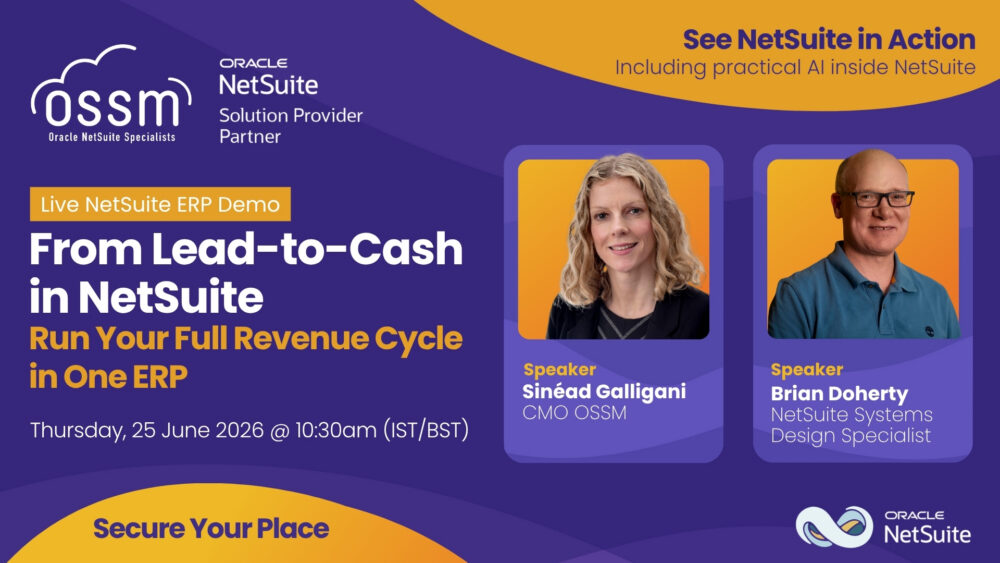
To see these capabilities in action, join our live From Lead-to-Cash in NetSuite demo on 25 June 2026, where we’ll show how AI, automation, and real-time visibility support the entire revenue cycle within a single ERP platform.
About the Author

David Burke
David Burke, Group CTO at The Noledge Group, leads the company’s technology strategy and oversees the design and delivery of both bespoke and off-the-shelf solutions. He is responsible for driving innovation across the Group’s product and service portfolio, ensuring customers benefit from scalable, future-ready cloud technologies.